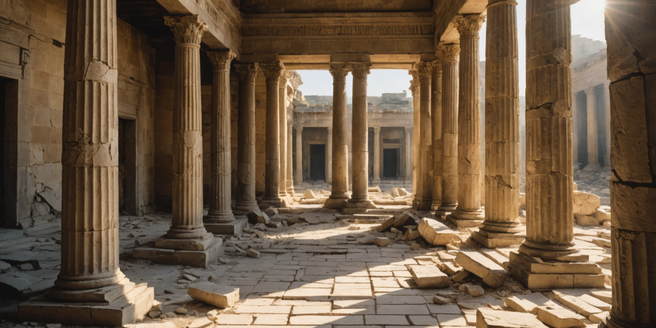
Understanding Rahab’s Historical Context
To truly understand Rahab’s significance, it is vital to delve into her historical backdrop. Living in ancient Jericho, Rahab was a Canaanite, a group often at odds with the Israelites. Despite this, she played a key role in aiding Israelite spies, an act that relied on both courage and cunning. Jericho’s location at the edge of Canaan strategically placed it at the center of many conflicts. Understanding these dynamics sheds light on Rahab’s decision to protect the spies. Her action can be seen as a moment of profound personal risk, challenging cultural norms of her time. It also signifies an integration of outside belief into a predominantly Israelite narrative. Rahab’s story holds as much about her personal faith journey as it does about the larger socio-political climate of ancient Canaan.
The Significance of Rahab’s Faith
Rahab’s faith is depicted as remarkable due to its emergence amidst external adversity. Despite her people’s polytheistic traditions, Rahab recognized the sovereignty of the Israelite God. This profound acknowledgment led her to make life-altering decisions, aiding the spies sent by Joshua. Her faith transcended social barriers and resulted in protection for her family during Jericho’s conquest. This trust in a power greater than any earthly king demonstrated the depths of her belief. Rahab’s story underscores the transformative power of faith, showing that spiritual conviction can dismantle barriers of nationality and tradition. Her narrative invites readers to consider faith as an inclusive force, capable of bridging divides and fostering unity. This reflection on faith’s power presents a timeless message on the boundless potential of belief and trust.
Rahab’s Role in Biblical Redemption
Rahab emerges as a pivotal figure in the biblical narrative of redemption. Her assistance to the Israelite spies did not only ensure her own survival but also marked her as a key player in a larger divine plan. In the lineage of Jesus, Rahab’s inclusion underscores the theme of redemption that runs through biblical history. Her story illustrates that redemption is available to all, regardless of past misdeeds or social standing. Rahab’s transformation from an outsider to an integral member of the faith community signifies God’s willingness to embrace all who seek Him. This narrative highlights the universal nature of redemption, emphasizing that faith is not constrained by ethnicity or past deeds. Rahab’s legacy is a testament to the hope inherent in the redemption narrative, anchoring her role firmly in theological discussions about grace.
Lessons from Rahab’s Transformation
Rahab’s journey from a marginalized figure to an ancestor in the lineage of Christ offers profound lessons. Her story reflects the immense power of personal transformation initiated through faith. Rahab’s decision to protect the Israelite spies, based on her belief in their God, changed the course of her life forever. It illustrates how individual transformation can lead to communal benefits, as her family was spared during Jericho’s fall. Her life teaches that even from seemingly unfavorable beginnings, one can rise to a place of honor within God’s plan. Rahab’s transformation highlights the potential for change inherent in every person, urging introspection about one’s own life path and the influence of faith in overcoming obstacles. Her legacy is a beacon of hope, stressing the theme that redemption and personal growth are within reach for all.
Rahab’s Legacy in Faith and Redemption
Rahab’s story still resonates powerfully today, illustrating themes of overcoming, faith, and redemption. Her courageous stand in Jericho set forth a legacy that ripples through both history and theology. The integration of her line into the ancestry of David, and ultimately Jesus, symbolizes the inclusive nature of faith. It shows that the path to redemption and inclusion within God’s promise is available to all, regardless of one’s origins or past. Rahab’s legacy challenges modern believers to reflect on the boundaries of acceptance and the transformative power of faith. Her narrative urges an embrace of grace, a principle central to biblical teachings. Rahab serves as a reminder that faith can transcend societal limitations and redefine one’s destiny, beckoning all to explore their place within the continuum of faith and redemption.
Modern Reflections on Rahab’s Story
In today’s world, Rahab’s story invites reflection on faith, redemption, and inclusion. Her actions challenge modern perceptions of what it means to be faithful and how redemption can reshape lives. Rahab’s alignment with the Israelites poses questions about allegiance and identity, resonating with contemporary themes of seeking truth across cultural divides. Her legacy encourages conversations about acceptance and understanding within diverse communities of faith. Through Rahab, modern believers are encouraged to look beyond superficial barriers to find commonality in spiritual truth. Her willingness to embrace a foreign faith journey resonates with today’s search for meaning amidst diverse traditions. Rahab’s story invites reflection upon the nature of faith itself, urging exploration of its potential to unite rather than divide, showcasing a timeless message on the enduring power of belief and grace amid cultural diversity.